
📷 Image: Wikimedia Commons / Prime Minister's Office
Science
Three of the Eight Cheetahs Released by PM Modi in Kuno National Park Still Alive After Four Years
✍️ Amar Ujala · Madhya Pradesh
🗓 17 Sep 2026, 11:15 AM
👁 7
Four years after Prime Minister Narendra Modi released eight cheetahs in Madhya Pradesh's Kuno National Park, only three remain alive, while the breeding program led by Asha and Jwala has added new cubs to the Indian cheetah population.
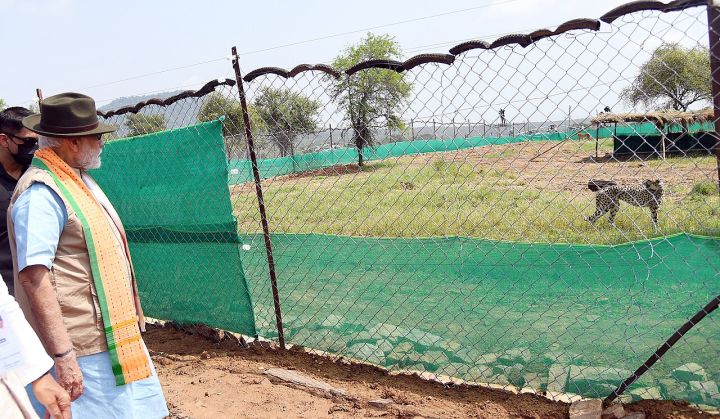
Madhya Pradesh's Kuno National Park marked a milestone in 2020 when Prime Minister Narendra Modi oversaw the release of eight cheetahs, the first such reintroduction in the country in decades. The animals, sourced from African reserves, were intended to re‑establish a native cheetah population in the central Indian grasslands.
A recent assessment by park officials shows that three of the original eight individuals are still alive. The others have succumbed to natural causes or health complications over the intervening years. The surviving cheetahs are now part of a monitored breeding program that aims to increase the genetic pool and ensure long‑term viability.
Conservationists Asha and Jwala have played a pivotal role in the program, successfully facilitating the birth of several cubs in recent months. Their efforts have expanded the fledgling cheetah family, bringing the total number of Indian cheetahs in the park to five, including the new generation.
The park's wildlife department continues to provide intensive veterinary care, habitat management, and anti‑poaching measures to safeguard the remaining cheetahs. While the survival rate underscores the challenges of reintroduction, the progress made by Asha, Jwala, and the park staff offers a hopeful outlook for the species' future in India.
Experts stress that sustained funding and community involvement will be crucial to maintain momentum and eventually allow the cheetah population to become self‑sustaining without further external introductions.
A recent assessment by park officials shows that three of the original eight individuals are still alive. The others have succumbed to natural causes or health complications over the intervening years. The surviving cheetahs are now part of a monitored breeding program that aims to increase the genetic pool and ensure long‑term viability.
Conservationists Asha and Jwala have played a pivotal role in the program, successfully facilitating the birth of several cubs in recent months. Their efforts have expanded the fledgling cheetah family, bringing the total number of Indian cheetahs in the park to five, including the new generation.
The park's wildlife department continues to provide intensive veterinary care, habitat management, and anti‑poaching measures to safeguard the remaining cheetahs. While the survival rate underscores the challenges of reintroduction, the progress made by Asha, Jwala, and the park staff offers a hopeful outlook for the species' future in India.
Experts stress that sustained funding and community involvement will be crucial to maintain momentum and eventually allow the cheetah population to become self‑sustaining without further external introductions.