
📷 Image: Times of India (via NewsData)
Science
NASA’s 1984 Space Shuttle Mission Sends 3,301 Bees to Test Honeycomb Building in Microgravity
✍️ Times of India
🗓 26 Aug 2026, 07:03 PM
👁 2
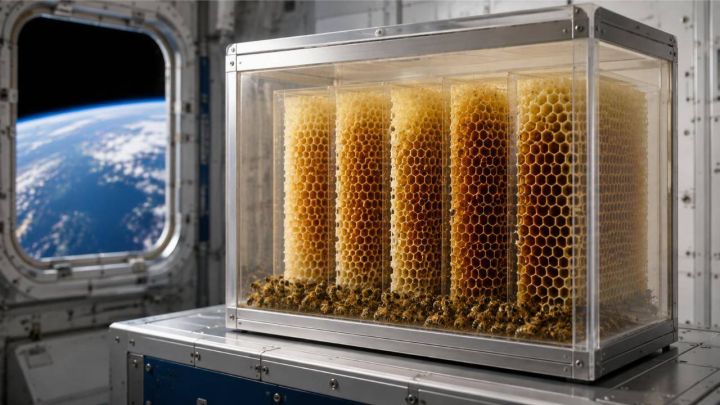
In 1984, NASA launched 3,301 honeybees aboard Space Shuttle Discovery to see if they could survive and construct honeycomb in microgravity; the insects adapted and produced roughly two metres of comb before returning.
The United States space agency dispatched a hive of 3,301 honeybees on the Space Shuttle Discovery during a 1984 mission, aiming to study insect behavior in a weightless environment. Researchers wanted to know whether the bees could survive the conditions of orbit and continue their characteristic construction of honeycomb.
During the first few hours in microgravity, several bees collided with the cabin walls, a reaction attributed to the sudden loss of gravity cues. Within a couple of days, the insects adjusted their flight patterns, moving more fluidly and exhibiting normal foraging activities.
By the time the shuttle prepared for re‑entry, the colony had built approximately 200 centimetres of honeycomb structure. Most of the bees remained alive, and the queen laid a batch of eggs, although none of the eggs hatched after the mission concluded.
The experiment demonstrated that honeybees can adapt to spaceflight and continue complex building tasks, offering insights for future long‑duration missions where biological systems may support life‑support processes.
During the first few hours in microgravity, several bees collided with the cabin walls, a reaction attributed to the sudden loss of gravity cues. Within a couple of days, the insects adjusted their flight patterns, moving more fluidly and exhibiting normal foraging activities.
By the time the shuttle prepared for re‑entry, the colony had built approximately 200 centimetres of honeycomb structure. Most of the bees remained alive, and the queen laid a batch of eggs, although none of the eggs hatched after the mission concluded.
The experiment demonstrated that honeybees can adapt to spaceflight and continue complex building tasks, offering insights for future long‑duration missions where biological systems may support life‑support processes.