
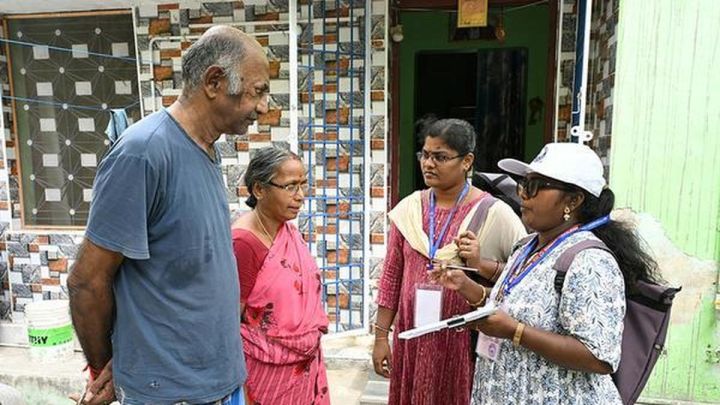
📷 Image: The Hindu (via NewsData)
National
Caste Recording to Feature 13 New Data Fields in Census 2027 Second Phase
✍️ The Hindu
🗓 19 Aug 2026, 10:39 AM
👁 1
The Registrar General and Census Commissioner has added 13 new caste-related data fields to the 40 questions for the second phase of Census 2027, marking a shift from the 2011 questionnaire.
The Registrar General and Census Commissioner of India (RG&CCI) has released a set of 40 questions for the second phase of the Census scheduled for 2027. Among these, 13 new data fields pertain specifically to caste, a category that was not captured in such detail in the 2011 census questionnaire.
These additional fields are intended to provide a more granular picture of India's social composition, enabling policymakers to design targeted welfare schemes. The inclusion reflects ongoing debates about the role of caste data in planning and resource allocation.
The revised questionnaire will be administered nationwide, with enumerators trained to record the new caste variables accurately. The RG&CCI has emphasized that the data will be anonymised and used solely for statistical purposes.
Stakeholders, including academic researchers and civil society groups, have welcomed the move, noting that richer caste data could improve the precision of socio‑economic analyses. The final results are expected to be published after the completion of the field operations.
The Census 2027, being the first to incorporate these expanded caste metrics, aims to set a new benchmark for demographic data collection in India.
These additional fields are intended to provide a more granular picture of India's social composition, enabling policymakers to design targeted welfare schemes. The inclusion reflects ongoing debates about the role of caste data in planning and resource allocation.
The revised questionnaire will be administered nationwide, with enumerators trained to record the new caste variables accurately. The RG&CCI has emphasized that the data will be anonymised and used solely for statistical purposes.
Stakeholders, including academic researchers and civil society groups, have welcomed the move, noting that richer caste data could improve the precision of socio‑economic analyses. The final results are expected to be published after the completion of the field operations.
The Census 2027, being the first to incorporate these expanded caste metrics, aims to set a new benchmark for demographic data collection in India.