
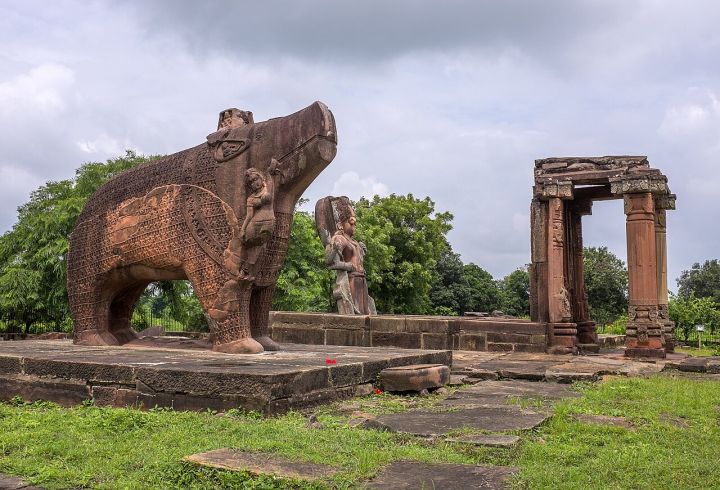
📷 Image: Wikimedia Commons / Itsmalay~commonswiki
Religion
1700-year-old Eran stone slab provides first visual of Lord Balarama’s mythic ‘embryo implantation’
✍️ Amar Ujala · Sagar
🗓 03 Sep 2026, 01:17 PM
👁 29
Archaeologists have uncovered a rare 5th‑6th century stone slab at the Eran site in Sagar, Madhya Pradesh, depicting the birth of Lord Balarama and the legendary ‘garbh‑pratyarpan’ (embryo implantation) story – the earliest known visual evidence of the myth.
Archaeologists working at the Eran archaeological complex in Sagar, Madhya Pradesh, have reported the discovery of a stone slab dating to the 5th‑6th century CE. The slab, measured in situ, bears carved reliefs that illustrate the birth of Lord Balarama and a scene interpreted as the mythological ‘garbh‑pratyarpan’, a ritual of embryo implantation described in ancient texts.
Scientific analysis of the stone’s patina and associated pottery places the artifact at roughly 1,700 years old, linking it to the Gupta‑era cultural horizon known locally as the Guptha period. The iconography is distinct from earlier depictions of Balarama, showing a narrative sequence rather than a static deity figure.
Experts say the find offers the earliest visual corroboration of a story that has hitherto been known only from literary sources. It adds a new dimension to the understanding of religious art and myth transmission in early medieval India, and may prompt a re‑examination of similar sites for comparable motifs.
The slab is now being conserved by the state archaeology department, with plans for display in the regional museum pending further study.
Scientific analysis of the stone’s patina and associated pottery places the artifact at roughly 1,700 years old, linking it to the Gupta‑era cultural horizon known locally as the Guptha period. The iconography is distinct from earlier depictions of Balarama, showing a narrative sequence rather than a static deity figure.
Experts say the find offers the earliest visual corroboration of a story that has hitherto been known only from literary sources. It adds a new dimension to the understanding of religious art and myth transmission in early medieval India, and may prompt a re‑examination of similar sites for comparable motifs.
The slab is now being conserved by the state archaeology department, with plans for display in the regional museum pending further study.