
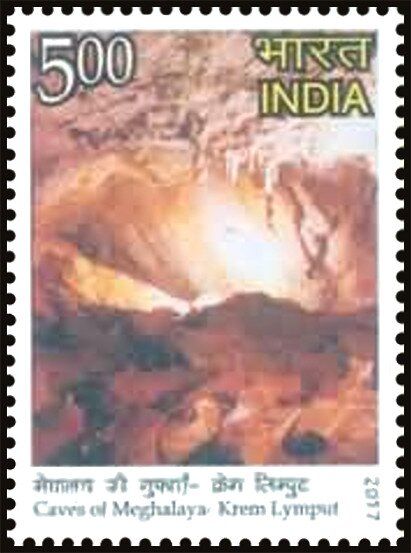
📷 Image: Wikimedia Commons / Post of India
Science
Ancient Meghalaya Cave Stalagmite Maps 6,000 Years of Monsoon Variability
✍️ India Today NE
🗓 05 Nov 2026, 01:38 PM
👁 10
Scientists have analysed a stalagmite from a Meghalaya cave, uncovering a continuous 6,000‑year record of monolith‑intensity in Northeast India.
Researchers from Indian institutes examined a stalagmite extracted from a limestone cave in Meghalaya’s Khasi Hills. Using uranium‑thorium dating, they established that the mineral grew continuously for roughly six millennia, preserving layers that correspond to successive monsoon seasons.
Geochemical analysis of the stalagmite’s oxygen isotopes revealed alternating periods of higher and lower rainfall, pinpointing phases of intensified monsoon activity around 4,500 years ago and weaker phases during 2,800‑2,300 years BP. The data align with other regional proxies, confirming a long‑term oscillation in the Indian Summer Monsoon.
The study provides a rare, high‑resolution climate archive for Northeast India, a region where instrumental records are sparse. By extending the monsoon timeline far beyond modern observations, the findings help climate models refine predictions of future monsoon behaviour under global warming.