
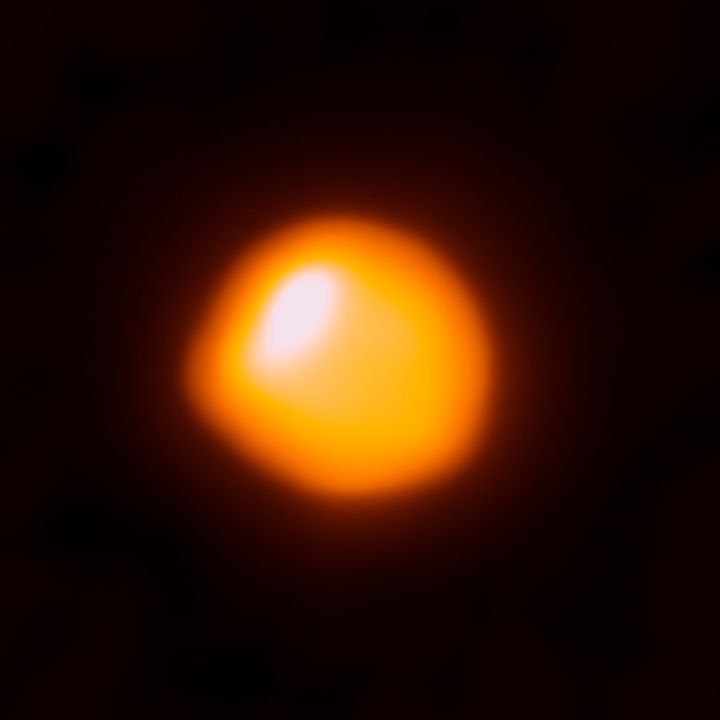
📷 Image: Wikimedia Commons / ALMA (ESO/NAOJ/NRAO)/E. O’Gorman/P. Kervella
Science
Scientists Reveal Hidden Star Near Betelgeuse, Raising Real Supernova Threat
✍️ WION
🗓 09 Oct 2026, 06:47 AM
👁 17
Astronomers have identified a previously unseen star close to Betelgeuse, suggesting the red supergiant may pose a genuine supernova risk to Earth.
Astronomers using data from the Hubble Space Telescope and ground‑based observatories have discovered a faint companion star orbiting the well‑known red supergiant Betelgeuse in the constellation Orion. The new star, about 0.5 solar masses, was previously hidden by the bright glare of its primary.
The discovery, published in the journal *Nature Astronomy*, indicates that Betelgeuse’s mass loss and eventual supernova explosion could be influenced by this companion. While Betelgeuse is roughly 640 light‑years from Earth, a supernova would appear as a bright point in the night sky but is too distant to threaten life on our planet.
Scientists emphasize that the timing of Betelgeuse’s potential supernova remains uncertain, with estimates ranging from a few thousand to a few million years. Nonetheless, the finding refines models of how massive stars evolve and explode.
The study also highlights the importance of high‑resolution imaging in detecting faint companions around bright stars, a technique that could uncover similar systems elsewhere in the galaxy.
The discovery, published in the journal *Nature Astronomy*, indicates that Betelgeuse’s mass loss and eventual supernova explosion could be influenced by this companion. While Betelgeuse is roughly 640 light‑years from Earth, a supernova would appear as a bright point in the night sky but is too distant to threaten life on our planet.
Scientists emphasize that the timing of Betelgeuse’s potential supernova remains uncertain, with estimates ranging from a few thousand to a few million years. Nonetheless, the finding refines models of how massive stars evolve and explode.
The study also highlights the importance of high‑resolution imaging in detecting faint companions around bright stars, a technique that could uncover similar systems elsewhere in the galaxy.