
Agriculture
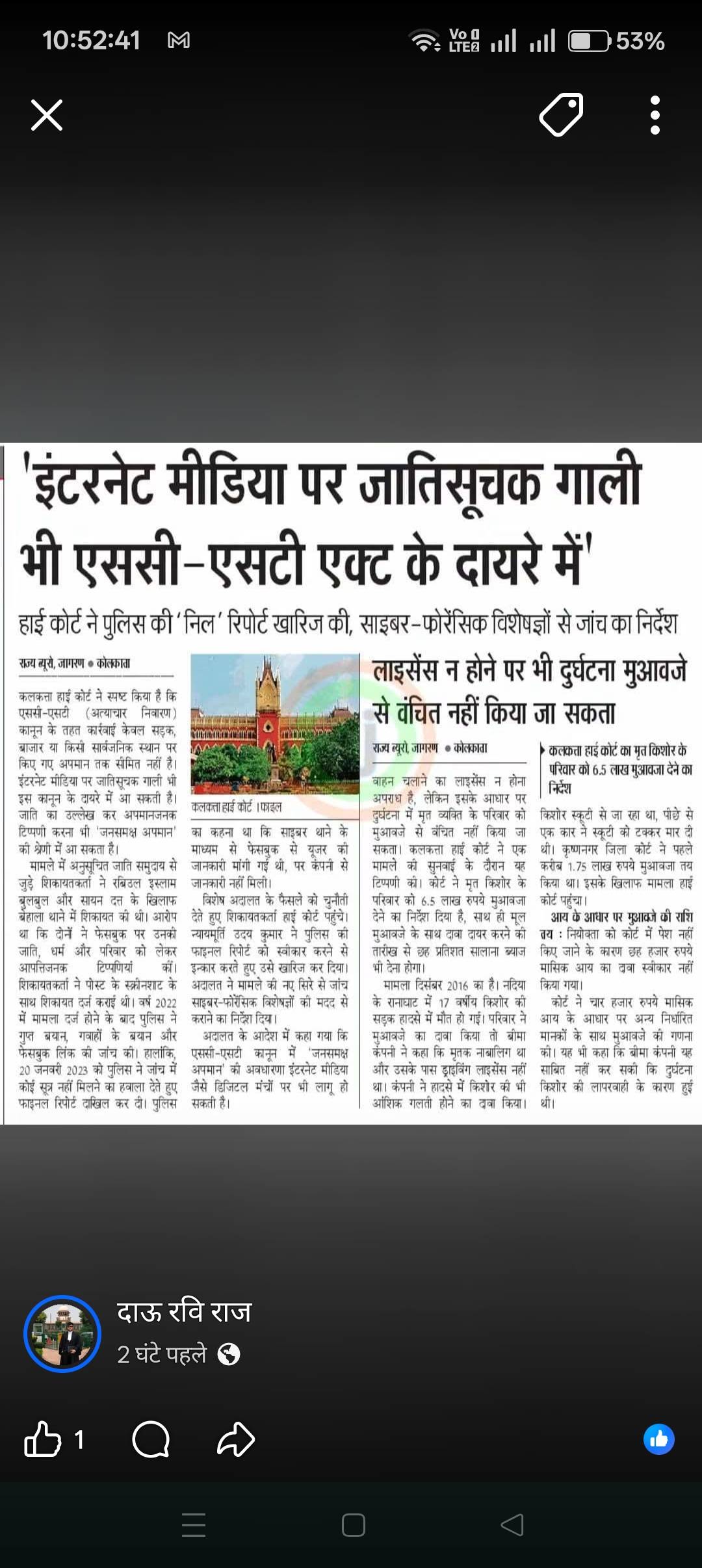
'Caste-related abuse on internet media also comes under the ambit of SC-ST Act'
'Caste-related abuse on internet media also comes under the ambit of SC-ST Act'
High Court rejects police's 'nil' report, orders probe by cyber forensic experts
State Bureau, Jagran Kolkata
The Calcutta High Court has clarified that action under the SC/ST (Prevention of Atrocities) Act is not limited to insults made on the street, in a marketplace, or in any public place. Caste-based slurs on the internet also fall within the scope of this law. Making derogatory comments based on caste also constitutes "public insult."
In this case, the complainant, belonging to the Scheduled Caste community, filed a complaint at the Behala police station against Rabithal Islam Bulbul and Sayan Dutt. The complainant alleged that the two had posted derogatory comments on Facebook about his caste, religion, and family. The complainant filed the complaint along with screenshots of the posts. After the case was registered in 2022, the police
Anonymous statements, witness statements, and Facebook links were examined. However, on January 20, 2023, the police filed a final report, citing no leads in the investigation.
Calcutta High Court File
He said that user information was sought from Facebook through the cyber police station, but no information was received from the company.
The complainants challenged the special court's decision and approached the High Court. Justice Uday Kumar refused to accept the police's final report and dismissed it. The court ordered a fresh investigation into the case with the help of cyber forensic experts.
The court order said that the concept of 'public insult' in the SC-ST Act can also be applied to digital platforms like internet media.
Accident compensation cannot be denied even if you do not have a license.
State Bureau, Jagran Kolkata
Not having a driving license is a crime, but it cannot be used to deny compensation to the family of a person who died in an accident. The Calcutta High Court made this observation during a case. The court ordered compensation of ₹6.5 lakh to the family of the deceased teenager, along with six percent annual interest on the original compensation from the date of filing the claim.
The case dates back to December 2016. A 17-year-old boy died in a road accident in Ranaghat, Nadia. When the family claimed compensation, the insurance company stated that the deceased was a minor and did not have a driving license. The company claimed that the boy was partially at fault for the accident.
Calcutta High Court orders Rs 6.5 lakh compensation to the family of the deceased teenager
The teenager was riding a scooter when a car struck him from behind. The Krishnanagar District Court initially awarded a compensation of approximately ₹1.75 lakh (approximately ₹1.75 lakh). The case was challenged in the High Court.
The claim of Rs 6,000 monthly income was not accepted as the employer did not present the compensation amount on the basis of income in the court.
The court calculated compensation based on a monthly income of 4,000 rupees, along with other prescribed criteria. It also stated that the insurance company could not prove that the accident was caused by the teenager's negligence.
High Court rejects police's 'nil' report, orders probe by cyber forensic experts
State Bureau, Jagran Kolkata
The Calcutta High Court has clarified that action under the SC/ST (Prevention of Atrocities) Act is not limited to insults made on the street, in a marketplace, or in any public place. Caste-based slurs on the internet also fall within the scope of this law. Making derogatory comments based on caste also constitutes "public insult."
In this case, the complainant, belonging to the Scheduled Caste community, filed a complaint at the Behala police station against Rabithal Islam Bulbul and Sayan Dutt. The complainant alleged that the two had posted derogatory comments on Facebook about his caste, religion, and family. The complainant filed the complaint along with screenshots of the posts. After the case was registered in 2022, the police
Anonymous statements, witness statements, and Facebook links were examined. However, on January 20, 2023, the police filed a final report, citing no leads in the investigation.
Calcutta High Court File
He said that user information was sought from Facebook through the cyber police station, but no information was received from the company.
The complainants challenged the special court's decision and approached the High Court. Justice Uday Kumar refused to accept the police's final report and dismissed it. The court ordered a fresh investigation into the case with the help of cyber forensic experts.
The court order said that the concept of 'public insult' in the SC-ST Act can also be applied to digital platforms like internet media.
Accident compensation cannot be denied even if you do not have a license.
State Bureau, Jagran Kolkata
Not having a driving license is a crime, but it cannot be used to deny compensation to the family of a person who died in an accident. The Calcutta High Court made this observation during a case. The court ordered compensation of ₹6.5 lakh to the family of the deceased teenager, along with six percent annual interest on the original compensation from the date of filing the claim.
The case dates back to December 2016. A 17-year-old boy died in a road accident in Ranaghat, Nadia. When the family claimed compensation, the insurance company stated that the deceased was a minor and did not have a driving license. The company claimed that the boy was partially at fault for the accident.
Calcutta High Court orders Rs 6.5 lakh compensation to the family of the deceased teenager
The teenager was riding a scooter when a car struck him from behind. The Krishnanagar District Court initially awarded a compensation of approximately ₹1.75 lakh (approximately ₹1.75 lakh). The case was challenged in the High Court.
The claim of Rs 6,000 monthly income was not accepted as the employer did not present the compensation amount on the basis of income in the court.
The court calculated compensation based on a monthly income of 4,000 rupees, along with other prescribed criteria. It also stated that the insurance company could not prove that the accident was caused by the teenager's negligence.